How Virtual Physical Therapy Retrains Your Body
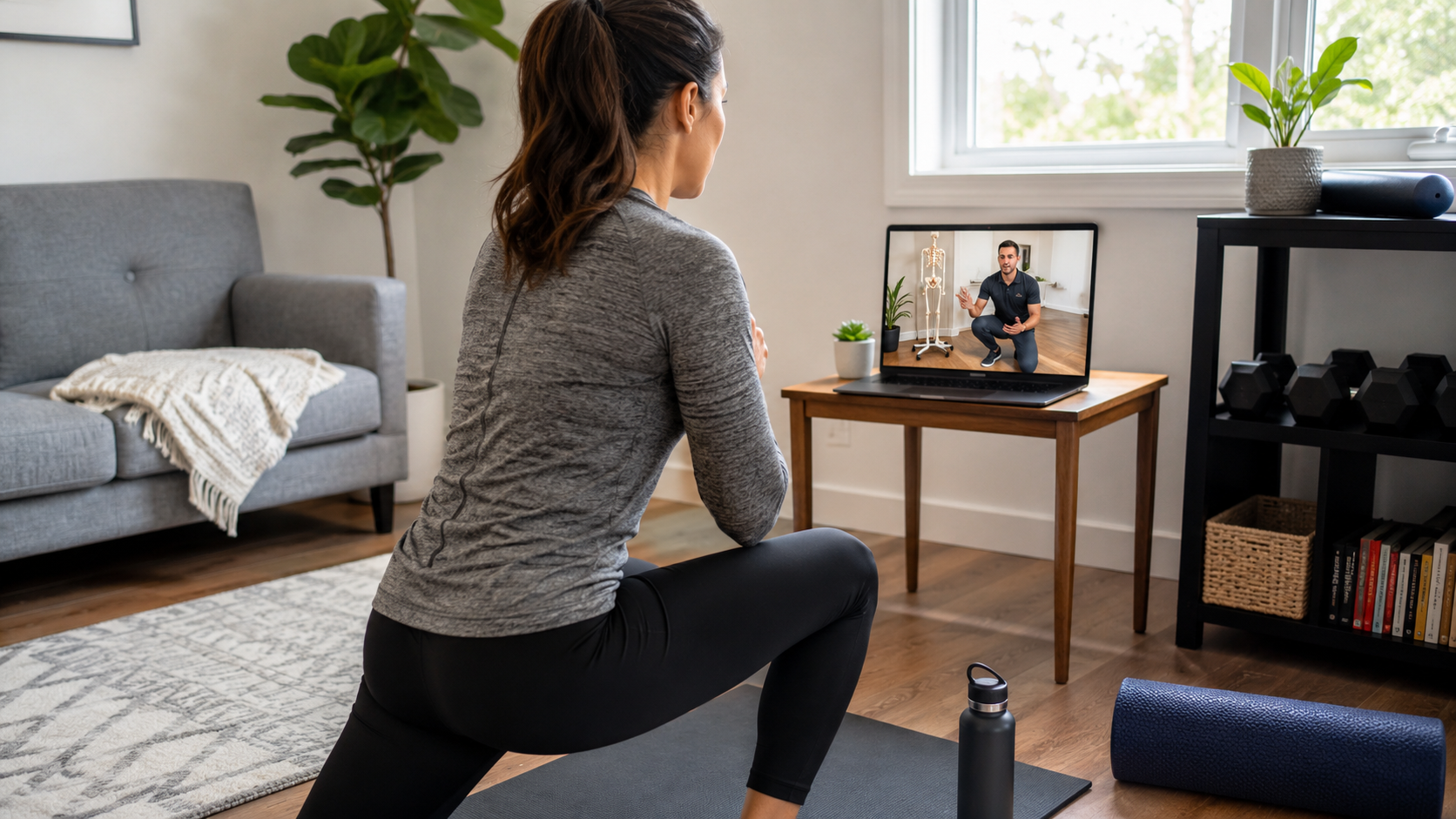
Why Virtual Physical Therapy Works And Why It Might Be Exactly What You Need
You know you should see a physical therapist, but your calendar is a fortress.
Between back-to-back meetings and daily life, finding a 2-hour window to commute to a clinic, sit in a waiting room, just to get a generic treatment? That’s impossible.
But pain doesn’t care about your schedule.
So, you consider virtual physical therapy. Yet, you’re skeptical. You’ve likely wondered: Can someone actually help me through a screen? Don't I need hands-on treatment to get better?
The truth is that for the active adult, virtual care isn’t a "backup plan." In many cases, it is the most effective path to restoring control.
By removing the clinical setting, we shift the focus from a therapist "fixing" you to you retraining your body in the exact environment where your pain actually happens.
The "Home-Court Advantage" of Movement Science
Let’s address the manual therapy question directly. It is true that a therapist cannot physically move your joints through a camera.
However, in modern movement science, we know that manual therapy is often just a temporary "reset." The real, lasting change happens when you retrain your nervous system to coordinate movement.
Research in the journal Physical Therapy has shown that for conditions like low back pain and knee issues, telehealth outcomes are comparable to in-person visits. There is a specific reason for this: context.
When you are in a sterile clinic, your brain is in "patient mode." When you are in your living room, your office, or your gym, your brain is in "life mode."
By retraining your movement in your own space, your nervous system integrates those new patterns much faster. You aren't learning how to move on a clinic table; you are learning how to move in your life.
What Actually Happens in a Virtual Session?
A high-level virtual session isn't just a video call; it’s a deep dive into your movement biography.
The Environmental Audit
In a clinic, we can only guess why your back hurts at work. In a virtual session, we can see the chair you sit in for eight hours. We can see how you reach for your equipment in your home gym or how you navigate the stairs in your house.
These "environmental stressors" are often the root cause of chronic pain. Seeing them in real-time allows us to make the small, direct adjustments that a clinic visit would miss.
Neurological Retraining
Using the NeuroAlign Method, we coach you through precise movements designed to "re-map" how your brain perceives your body. Because you are the one performing the movement, and not having it done to you, your brain takes ownership of the change.
This is why many of our clients see functional progress in just 2 to 4 sessions. We aren't just giving you exercises; we are updating your movement software.
Who Is Virtual PT Best For?
While some complex post-surgical cases benefit from a hybrid approach, many common issues respond exceptionally well to remote care.
The Deskbound Professional: We can assess your workstation and provide spine-first rehab training to resolve neck and back tension exactly where it starts.
The Performance Athlete: We can watch you lift, run, or move in your training space, ensuring your form is built for longevity rather than just a quick fix.
The Frequent Traveler: Virtual sessions make sure you never lose momentum. Whether you are in a hotel or a different city, your recovery remains consistent.
Moving Toward Movement Autonomy
Many virtual platforms are "exercise mills"; they give you a generic list of videos and wish you luck. At Fit-Habilitation, we do the opposite. You work one-on-one with a Doctor of Physical Therapy who specializes in movement health.
We don't want you to be a patient forever. We want to give you the tools to be the expert on your own body. Virtual PT is the ultimate tool for movement autonomy because it proves that you have the power to resolve your pain exactly where you are.
Insights for Your Virtual Journey
1. How do I know if I'm "moving right" without a therapist touching me?
We use visual "markers" and internal "feel" cues. Our DPTs are trained to spot subtle compensations, like hip hiking or rib cage flaring, through high-definition video. We teach you how to feel those compensations yourself, which is a much more valuable skill than having someone move your leg for you.
2. What if I don't have fancy gym equipment?
You don't need it. Your body and the environment you live in are the best tools we have. We are experts at using what you have (a staircase, a heavy book, or a door frame) to create a high-quality retraining environment.
3. Is virtual PT safe if I have a "serious" injury?
If you have "red flags", like sudden loss of strength or changes in sensation, we will always refer you for an in-person medical evaluation. But for most muscle, joint, and nerve issues, virtual care is perfectly safe because we prioritize controlled, risk-free movement.
4. How do I get my camera set up?
It is simpler than you think. You just need enough space to move and a way to prop up your phone or laptop. We spend the first few minutes of our initial session ensuring we have the best view to analyze your movement effectively.
5. Can this help with my "posture"?
Posture isn't a static position you "hold"; it's a dynamic way you organize your body against gravity. Virtual PT is actually the best way to address this because we can see how you organize your body in the places where you spend the most time.
Reclaim Your Time and Your Health
Stop waiting for a "gap" in your schedule to feel better. Choosing virtual physical care is choosing your time, your life, while prioritizing your longevity.
CTA BUTTON: Book your virtual movement assessment today.
Experience a smarter way to retrain your body, exactly where you are.
Disclaimer: We are passionate about sharing movement science and recovery tips to help you live a vibrant, active life. However, the information provided on this blog is strictly for educational purposes and should not be considered a substitute for personalized medical advice, diagnosis, or treatment. Every body is unique! Always consult with a Doctor of Physical Therapy or your primary physician before starting any new exercise or rehabilitation program to ensure it is safe and appropriate for your specific needs.
