How to Solve Chronic Neck Pain by Retraining Your Movement
The Real Reason Your Neck Pain Keeps Coming Back
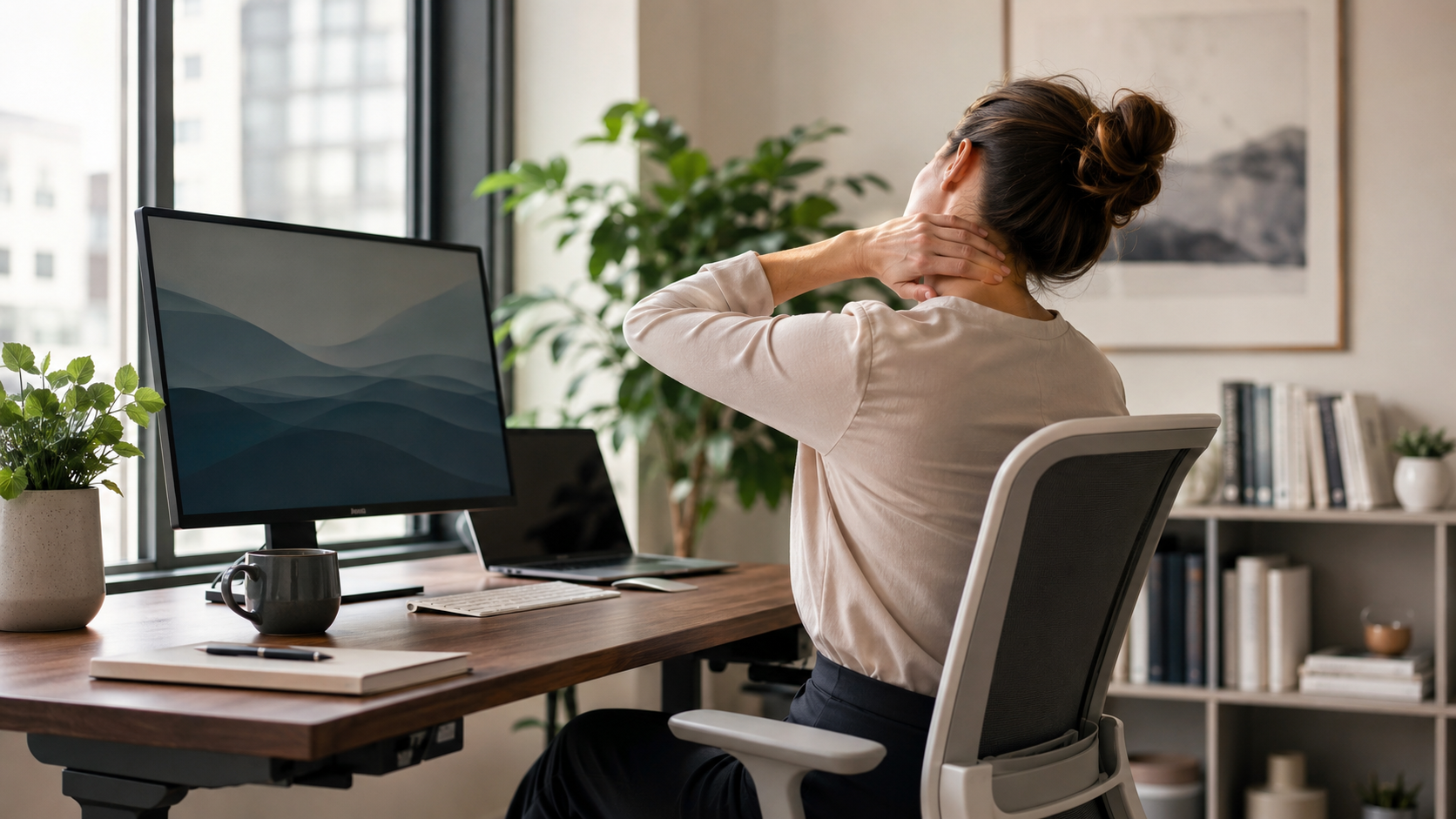
You’ve got “them” all. The high-end ergonomic chair. The standing desk. Even the foam roller and massage gun collections gathering dust in the corner.
Yet by Tuesday afternoon, that familiar, heavy tension is creeping back into your shoulders. By Friday, you’re sick with headaches. And the weekend? That’s spent "recovering" just to survive the next work week. Again.
If you feel like you're constantly hitting "snooze" on a warning light, it's because you're treating the symptom, not the engine.
The problem isn't your willpower or your furniture. The problem is that most treatments look at the neck as an isolated part.
At Fit-Habilitation, we don't just "fix" your posture; we retrain your body. By focusing on the relationship between your brain and your muscles, we help you break the cycle of recurring tension and reclaim your movement health.
The Posture Myth: Why "Sitting Straight" Isn't the Answer
We are often told that "bad posture" is the root of neck pain.
However, research published in the Journal of Orthopaedic & Sports Physical Therapy (JOSPT) suggests that the specific position of your spine matters less than you think. The real issue isn't the position you are in; it is being stuck in it.
Your body adapts to what you do most. If you spend eight hours a day at a desk, your brain begins to treat that stillness as the default. Your stabilizing muscles go "quiet," and your larger moving muscles stay "on" to hold you up.
This is why traditional posture correction therapy often feels like a chore. If you have to constantly remind yourself to "sit up straight," you are using the wrong muscles for the job.
True relief happens when your body automatically returns to a comfortable, neutral position, without you having to think about it.
The Spine-First Connection: Looking Below the Neck
In movement science, we know that neck pain is often due to stiffness in the mid-back (thoracic spine). If your mid-back is locked up from hours of leaning forward, your neck has to move twice as much to compensate.
No amount of neck pain PT will work if the segments below it are stuck.
Our process begins with a spine-first assessment. We look at how your ribs move, how your shoulder blades glide, and how your mid-back rotates. By restoring movement to the foundation, we take the mechanical "overload" off your neck, allowing the tension to finally settle.
Retraining the Pattern: The NeuroAlign Method
Movement isn't just about muscle strength; it’s about how your brain coordinates those muscles.
When you have been in pain for a long time, your brain creates "protective habits", chronic guarding that you can't just stretch away.
This is where our proprietary NeuroAlign Method changes the game. We use specific movement sequences to "reset" these habits. Instead of just pulling on a tight muscle, we show your brain that it is safe to let that muscle relax.
This is how we achieve rapid, clear results, with many of our clients feeling a significant shift in their tension levels and a total resolution of "desk-day" fatigue in just 2 to 4 sessions.
Why Your Headaches Are Actually a Stability Issue
Many of the headaches desk workers experience (cervicogenic headaches) start at the base of the skull. When the deep, small stabilizers in the front of your neck stop doing their job, the muscles at the back of your head have to work overtime to keep your eyes level with your screen.
The headache is the signal; the lack of stability is the source.
Our approach to neck pain PT focuses on waking up those deep stabilizers. When the right muscles take over the job of supporting your head, the tension at the base of your skull and the headaches that come with it often disappear.
The Hybrid Model: Care That Fits an Elite Schedule
We understand that for an executive or a busy professional in New York or Chicago, the biggest obstacle to recovery is the clinic itself. Traditional PT requires commutes and waiting rooms that eat into your productivity.
Our hybrid concierge model removes those barriers. We can assess your workstation virtually to see the "real-world" triggers for your pain, or provide one-on-one care in your home or club.
This isn't just a convenience; it is a clinical advantage. When we see you in the environment where your pain actually happens, we can make the direct, high-impact adjustments that a clinic visit would miss.
Insights for Lasting Relief
1. Why does my neck feel tight again right after a massage?
Massage targets the muscle tissue, but it doesn't change the message your brain sends. If your brain still feels the need to "protect" your neck, it will tighten those muscles right back up. We focus on the root-cause retraining that tells your brain the "threat" is over.
2. Can virtual PT really fix my posture?
Yes. In many ways, it’s better. We can see your actual desk, your monitor height, and how you sit while working. We coach you through the NeuroAlign Method in your own space, helping new habits stick much faster.
3. Do I need an MRI for my neck tension?
Usually, no. For most cases of mechanical neck pain, an MRI won't reveal the movement habits or muscle imbalances that are actually causing the problem. A Doctor of Physical Therapy can perform a physical assessment that is much more useful for building a plan that works.
4. Is "Text Neck" a real thing?
The weight on your spine increases as your head tilts forward. At a sharp angle, your head can put up to 60 pounds of pressure on your neck. We don't tell you to stop using your phone; we retrain your body to handle those loads more efficiently and move out of those positions more often.
5. How do I know if my headache is coming from my neck?
If your headache is one-sided, triggered by certain neck movements, or starts at the base of your skull and "wraps" around to your forehead, it is likely related to your neck. These types of headaches respond very well to specialized neck pain PT.
Reclaim Your Focus and Your Health
Wherever you are, your neck tension shouldn't be the loudest thing in the room.
Stop fighting tension and start retraining your system for lasting resilience. It’s time to move past the temporary fixes and invest in your longevity.
CTA BUTTON: Schedule your private movement assessment today.
Begin your path to lasting relief.
Disclaimer: We are passionate about sharing movement science and recovery tips to help you live a vibrant, active life. However, the information provided on this blog is strictly for educational purposes and should not be considered a substitute for personalized medical advice, diagnosis, or treatment. Every body is unique! Always consult with a Doctor of Physical Therapy or your primary physician before starting any new exercise or rehabilitation program to ensure it is safe and appropriate for your specific needs.
